LOGBOOK · 2026-11-22 · GRADE A: SYSTEMATIC REVIEW (433 BIOASSAYS) + FIELD TRIAL (2026)
Aedes repellency: 433 bioassays & Mali patio trial
Why spatial avoidance drops from 77.3% to 44.0% in resistant Aedes aegypti, and how six consumer patio devices performed under wind-controlled field traps.
ANSWER CAPSULE · AEDES REPELLENCY & CONSUMER HARDWARE
Across 433 Aedes aegypti bioassays reviewed in 2025, insecticide resistance cut spatial avoidance from 77.3 percent to 44.0 percent while contact repellency fell from 92.2 percent to 74.1 percent. In a 2026 wind-controlled Mali trial, only heated transfluthrin units cut Aedes over 93 percent, whereas citronella candles and ultrasonic gadgets failed.
Households shopping for backyard mosquito control face a confusing market split between skin-applied actives and patio hardware. Two recent peer-reviewed evaluations clarify where chemical deterrence holds up and where money is wasted. First, a 2025 PRISMA systematic review in Parasites & Vectors (Parasites & Vectors 2025, 433 Aedes Repellency Bioassays) synthesized 46 studies published between 1990 and 2023 covering 751 identified experiments and 433 lowest-effective-dose bioassays in Aedes aegypti. Second, a 2026 wind-controlled field study in Frontiers in Insect Science (Frontiers in Insect Science 2026, Mali Consumer Repellent Trial) tested six off-the-shelf spatial devices side by side across urban Aedes and rural Anopheles plots.
Combined with European surveillance documenting invasive Aedes albopictus expansion across Mediterranean cities (Insects 2026, European Vector Control Review) and a fresh ClinicalTrials.gov registry audit retrieved on 2026-11-22, these datasets expose a stark operational rule: behavioral avoidance is neither guaranteed across resistant strains nor achieved by botanical candles or ultrasonic emitters.
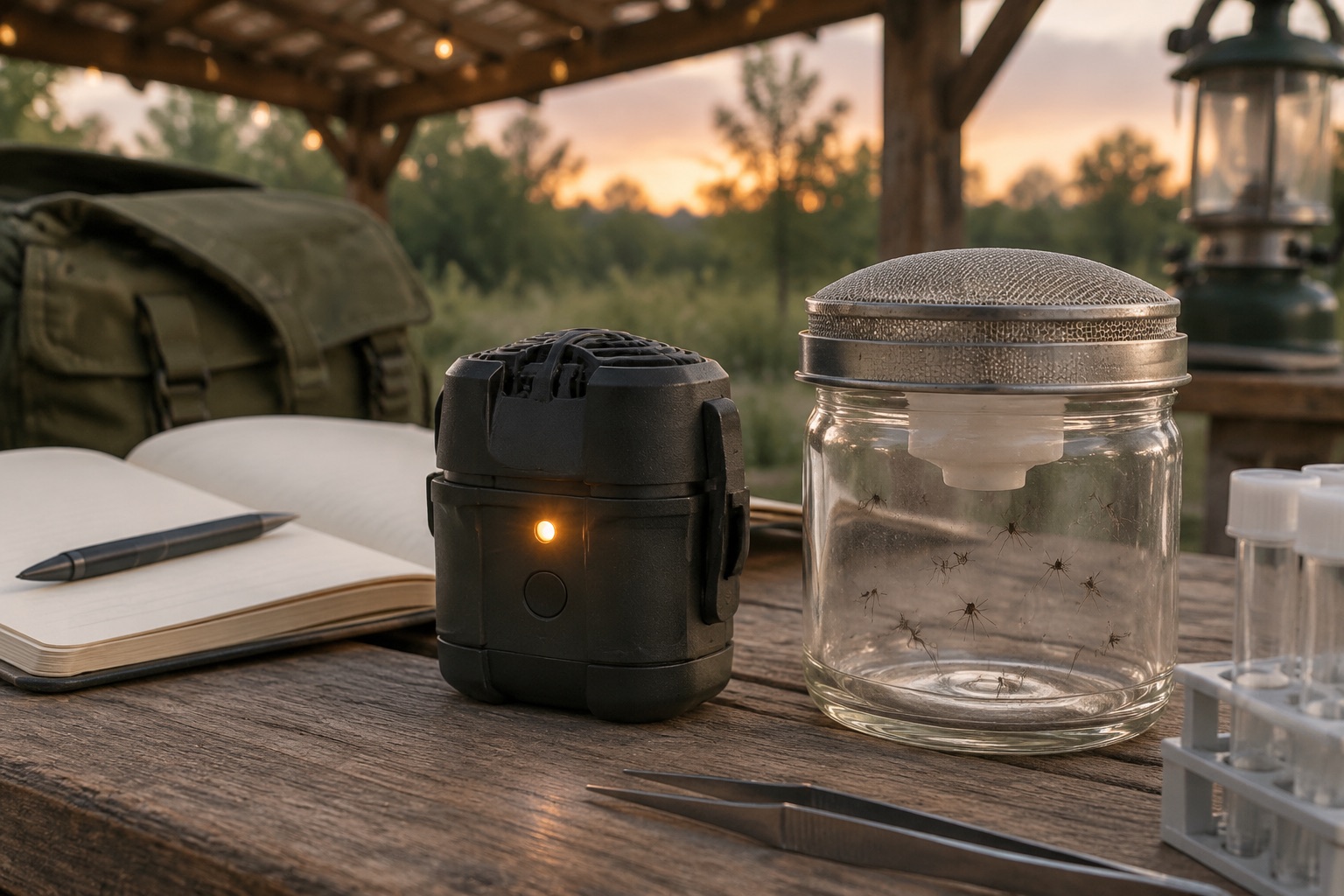 FIELD EVIDENCE 016 · MALI SPATIAL BIOASSAY BENCH
01Bioassay synthesis: 433 assays reveal a 33-point spatial repellency collapse
Entomologists divide chemical avoidance into two distinct mechanisms. Contact repellency (irritancy) occurs after a female mosquito lands on a treated surface, picks up molecules on her tarsal chemoreceptors, and takes off before taking a blood meal. Spatial repellency occurs at a distance in the vapor phase, triggering olfactory and sensory disorientation before the insect ever touches skin, clothing, or netting.
In the 2025 Parasites & Vectors systematic review, investigators screened 543 records across PubMed, BVS, and SciELO, analyzing 433 standardized lowest-effective-dose bioassays run via excito-repellency chambers, high-throughput screening systems (HITSS), and arm-in-cage protocols. Pyrethroids accounted for 86.6 percent of all evaluated bioassays, followed by organochlorines at 9.4 percent. Across the full dataset, 69.8 percent of bioassays demonstrated measurable repellent behavior.
The decisive operational warning emerges when those 433 assays are stratified by mosquito resistance status. In insecticide-susceptible Aedes aegypti colonies, contact repellency was observed in 92.2 percent of assays and spatial repellency in 77.3 percent. In resistant populations, contact repellency dropped to 74.1 percent, while spatial repellency collapsed to just 44.0 percent, a 33.3-percentage-point loss. Because most municipal spray trucks and household perimeter sprays rely on pyrethroids, sub-lethal avoidance can push resistant urban Aedes away from sprayed walls without killing them, leaving neighbors or unexposed skin vulnerable unless personal skin protection is maintained.
Crucially, the authors also documented widespread methodological drift: many published repellency studies failed to comply fully with World Health Organization (WHO) or US Environmental Protection Agency (EPA) testing guidelines, particularly around standardized human-attractant controls and dose-response documentation. When sub-lethal behavioral avoidance pushes a resistant mosquito off a treated wall without killing her, she retains full flight capacity to locate an untreated person nearby. Readers comparing marketing claims on retail packaging should treat any single laboratory cage claim cautiously unless replicated under wind-controlled field traps.
This behavioral resistance bottleneck carries immediate consequences for temperate urban outbreaks as well. As documented in a 2026 Mediterranean vector-control review in Insects (Insects 2026, European Vector Control Review), the northward expansion of invasive Aedes albopictus across Italy, France, Spain, and the wider Mediterranean basin has lengthened transmission seasons for autochthonous dengue, chikungunya, and West Nile virus. Travelers and residents in Europe frequently ask whether picaridin (known as icaridin under European Biocidal Products Regulation approvals) is permitted in Europe: unlike unverified ultrasonic plugs, icaridin/picaridin, DEET, and IR3535 remain formally evaluated active substances across European markets, though concentration caps and pediatric labels vary by member state.
02Mali 2026 field trial: six consumer spatial devices tested at 14 feet
To test whether retail patio products actually suppress host-seeking vectors outdoors, researchers in Mali, West Africa conducted paired field trials at an urban site (where taxonomic sampling of 400 females showed 55.50 percent Aedes, including 36.25% Ae. aegypti and 18.25% Ae. albopictus, plus 35.75 percent Culex) and a rural site (62.75 percent Anopheles and 36.50 percent Culex). Every plot met a baseline mosquito pressure floor of at least 60 mosquitoes per plot per hour.
Six consumer products were tested inside wind-controlled V-shaped plots surrounded by three CO2-baited CDC-UV traps positioned 14 feet (4.3 meters) from the device: a Dynatrap electronic unit (8.83% transfluthrin cartridge), a Thermacell E90 rechargeable unit (5.5% transfluthrin cartridge), a Hassana coil (0.08% meperfluthrin), a PIC coil (0.6% pyrethrins), a Cutter CitroGuard candle (3% citronella oil), and an Isotronic oscillating ultrasonic emitter.
Dunnett multiple-comparison tests against untreated control plots proved that only the two heat-activated transfluthrin devices achieved consistent, statistically significant suppression across both sites and multiple mosquito genera. At the urban site, mean Aedes trap captures fell from 14.33 ± 2.05 in controls to 0.88 ± 0.26 with Thermacell E90 (93.9% reduction, p < 0.0001) and 0.96 ± 0.27 with Dynatrap (93.3% reduction, p < 0.0001). Urban Culex fell from 8.83 ± 1.40 to 0.50 ± 0.21 (Dynatrap) and 1.00 ± 0.29 (Thermacell). At the rural site, mean Anopheles fell from 34.96 ± 7.20 to 1.63 ± 0.49 (Dynatrap, 95.3% reduction) and 2.50 ± 0.63 (Thermacell, 92.8% reduction), while rural Culex fell from 15.79 ± 2.91 to 2.63 ± 0.61 and 4.00 ± 0.69.
By contrast, the two burning mosquito coils cut urban Aedes modestly (7.50 for Hassana, 8.25 for PIC) and rural Anopheles moderately, yet completely failed to reduce rural Culex (negative mean differences of -3.208 and -7.333 versus control, p = 0.9366 and p = 0.3138) and exhibited wide night-to-night variability. Most importantly for household buyers, the 3% citronella candle (11.04 urban Aedes, p = 0.1007) and the ultrasonic emitter (15.33 urban Aedes, p = 0.9683, higher than untreated control) produced zero statistically significant protection on any mosquito genus at either site.
| CONSUMER DEVICE & ACTIVE | URBAN AEDES (CTRL 14.33) | URBAN CULEX (CTRL 8.83) | RURAL ANOPHELES (CTRL 34.96) | FIELD VERDICT |
|---|---|---|---|---|
| Thermacell E90 (5.5% transfluthrin, heated) | 0.88 ± 0.26 (-93.9%, p < 0.0001) | 1.00 ± 0.29 (-88.7%, p < 0.0001) | 2.50 ± 0.63 (-92.8%, p < 0.0001) | GRADE B · Effective in calm air |
| Dynatrap Electronic (8.83% transfluthrin) | 0.96 ± 0.27 (-93.3%, p < 0.0001) | 0.50 ± 0.21 (-94.3%, p < 0.0001) | 1.63 ± 0.49 (-95.3%, p < 0.0001) | GRADE B · Effective in calm air |
| Hassana Coil (0.08% meperfluthrin) | 7.50 ± 1.44 (-47.7%, p < 0.0001) | 6.54 est. (NS, p = 0.3971) | 14.13 est. (-59.6%, p < 0.0001) | GRADE C · Erratic + PM2.5 smoke |
| PIC Coil (0.6% pyrethrins) | 8.25 ± 1.57 (-42.4%, p = 0.0002) | 7.29 est. (NS, p = 0.7682) | 13.34 est. (-61.8%, p < 0.0001) | GRADE C · Erratic + PM2.5 smoke |
| Cutter CitroGuard Candle (3% citronella) | 11.04 ± 1.67 (NS, p = 0.1007) | 5.83 est. (NS, p = 0.1582) | 25.88 est. (NS, p = 0.1386) | GRADE D · Zero field efficacy |
| Isotronic Ultrasonic Emitter | 15.33 ± 1.83 (NS, p = 0.9683) | 8.17 est. (NS, p = 0.9941) | 31.92 est. (NS, p = 0.9497) | GRADE D · No measurable effect |
03Live ClinicalTrials.gov registry audit: 17 spatial repellent studies (119,000 participants)
To contextualize how consumer devices compare with public-health trials, we queried the live ClinicalTrials.gov API v2 registry on 2026-11-22 for all registered studies matching spatial repellent mosquito. Across 17 registered trials totaling 119,000 enrolled or planned participants, clinical evidence splits sharply between large passive humanitarian/arbovirus cohorts and commercial retail claims.
| TRIAL STATUS (RETRIEVED 2026-11-22) | STUDY COUNT | TOTAL PARTICIPANTS | REPRESENTATIVE TRIALS & GEOGRAPHY |
|---|---|---|---|
| Completed Trials | 8 studies | 55,413 | Peru arbovirus (NCT03553277, n=18,240), Syria displacement (NCT06917040, n=18,404), Sri Lanka Aedes (NCT05452447, n=6,949), Kenya malaria (NCT04766879, n=5,984), Mali (NCT04795648, n=1,911), Indonesia (NCT02294188, n=1,519) |
| Not Yet Recruiting (Upcoming Phase 3/4) | 2 studies | 55,399 | South Sudan humanitarian emanators (NCT07886281, n=32,584), Kenya LASER long-acting emanators (NCT07387341, n=22,815) |
| Active, Not Recruiting | 1 study | 166 | Mozambique IR3535 spatial repellent evaluation (NCT04419766, n=166) |
| Status Unknown | 2 studies | 8,022 | Uganda spatial repellent efficacy (NCT06232954, n=5,600) and housing study (NCT04622241, n=2,422) |
| Withdrawn Before Completion | 4 studies | 0 | Prior Kenya, Tanzania, and Uganda protocols superseded or consolidated (NCT02294201, NCT02294214, NCT02394522, NCT06122142) |
Methodology & Reproducible API Audit Box (ClinicalTrials.gov v2 · 2026-11-22)
Query endpoint: https://clinicaltrials.gov/api/v2/studies?query.term=spatial+repellent+mosquito&pageSize=50 executed on 2026-11-22. All 17 returned records were summed across protocolSection.statusModule.overallStatus and designModule.enrollmentInfo.count. Notably, completed arbovirus trials in Peru (18,240) and Sri Lanka (6,949) alongside the 2026 Maiduguri Lancet trial (The Lancet Infectious Diseases 2026) evaluated passive, flame-free transfluthrin sheets inside residential or shelter airspaces, whereas heated patio units like Thermacell lack randomized clinical disease endpoints and operate solely as short-range perimeter tools in low wind.
04Decision cutoffs: when skin repellents remain mandatory over spatial hardware
Two biological and physical thresholds determine whether a household needs skin-applied chemistry rather than relying on a tabletop device:
- 1. The 44% resistance cutoff in Aedes: When Aedes aegypti carries pyrethroid resistance, spatial avoidance in standardized bioassays falls to 44.0 percent. For day-biting dengue, Zika, and chikungunya vectors, skin-applied DEET (20 to 30%), picaridin (20%), or IR3535 (20%) remains non-negotiable because those molecules block mosquito odorant receptors independently of pyrethroid sodium-channel kdr mutations (explained in our kdr mechanism dossier).
- 2. Pediatric age cutoffs (0 to 36 months): Under CDC and AAP guidance, infants under 2 months must not receive topical chemical repellents (use fine-mesh stroller netting and long sleeves instead). From 2 months onward, DEET (up to 30%), picaridin, and IR3535 are permitted. Oil of lemon eucalyptus (OLE / PMD) carries a strict 3-year minimum age floor and must never be applied to toddlers under 36 months.
- 3. Wind and distance cutoff (14 ft / open breeze): Even high-performing heated transfluthrin units (Thermacell E90 and Dynatrap) were validated inside wind-controlled V-shaped plots at 14 ft. Open waterfront decks, hiking trails, or breezy balconies dilute volatile pyrethroids rapidly below effective vapor concentration; pair patio hardware with weekly source elimination from our ten-minute yard survey.
- 4. Indoor sleep protection vs patio smoke: Never burn mosquito coils inside bedrooms, tents, or enclosed porches, and discard citronella candles or ultrasonic plugs as ineffective gadgets. Where malaria or nocturnal Culex vectors enter sleeping quarters, dual-active bed nets or passive shelter emanators tested in the Maiduguri humanitarian trial remain the evidence-graded standard.
Sources verified 2026-11-22: Parasites & Vectors 2025 · Frontiers in Insect Science 2026 · Insects 2026 · ClinicalTrials.gov API v2.
05Frequently asked questions
Do citronella candles or ultrasonic mosquito repellers work outdoors?
No. In a 2026 wind-controlled field trial in Mali published in Frontiers in Insect Science, a 3% citronella candle (p = 0.1007 vs control) and an oscillating ultrasonic device (p = 0.9683 vs control) produced zero statistically significant reductions in Aedes, Culex, or Anopheles captures at 14 feet.
Why do spatial repellents work worse against insecticide-resistant Aedes aegypti?
A 2025 PRISMA systematic review of 433 bioassays in Parasites & Vectors found that spatial repellency fell from 77.3 percent in susceptible Aedes aegypti colonies to 44.0 percent in resistant populations, largely because 86.6 percent of spatial assays tested pyrethroids that share target-site or metabolic pathways.
Should I use a heated transfluthrin device instead of DEET or picaridin on skin?
Use heated transfluthrin devices (such as Thermacell E90 or Dynatrap, which cut Aedes catches by 93% in calm Mali plots) only as a stationary patio supplement in low wind. When walking, hiking, in breezy outdoor spaces, or in dengue-endemic zones, apply EPA-registered DEET, picaridin, or IR3535 directly to exposed skin.