LOGBOOK · 2026-11-12 · GRADE A: CLUSTER-CONTROLLED HUMANITARIAN TRIAL (2026)
Spatial repellents cut malaria 29% in humanitarian crisis trial
Passive transfluthrin emanators provide continuous airborne protection in open shelters, collapsing resistant Anopheles vector density by 98% where bed nets struggle.
ANSWER CAPSULE · HUMANITARIAN VECTOR CONTROL
A six-month pragmatic controlled trial in 24 Nigerian displacement camps published in 2026 confirms that passive transfluthrin spatial repellent emanators reduced malaria infection incidence by 29 percent (IRR 0.713) and pyrethroid-resistant vector density by 97.7 percent among 1,655 children, establishing volatile emanators as an effective tool where bed nets cannot easily hang.
Every humanitarian emergency creates an immediate vector-borne disease crisis. When armed conflict, floods, or political upheaval displace populations into malaria-endemic regions, families arrive stripped of formal housing and basic public health infrastructure. According to United Nations humanitarian assessments, more than 300 million people required urgent humanitarian assistance in 2025, and an estimated two-thirds of the world's extreme poor will reside in fragile and conflict-affected settings by 2030. In these environments, Plasmodium falciparum malaria remains the leading cause of preventable childhood morbidity and mortality. Yet the global community's two primary vector-control interventions, long-lasting insecticidal nets (LLINs) and indoor residual spraying (IRS), face crippling operational and biological bottlenecks inside informal camps.
A definitive milestone in humanitarian entomology arrived in 2026 with the publication of a six-month, two-arm pragmatic cluster-controlled clinical trial in The Lancet Infectious Diseases (The Lancet Infectious Diseases 2026, Maiduguri IDP Trial, registered on ClinicalTrials.gov NCT06179732). Conducted across 24 camps for internally displaced persons (IDPs) in Maiduguri, Borno State, Nigeria, the trial evaluated long-lasting spatial repellent emanators releasing volatile transfluthrin in households housing 1,655 children. The intervention achieved a statistically significant 28.7 percent reduction in malaria infection incidence (incidence rate ratio 0.713, 95% CI 0.584 to 0.869; p = 0.001) and a 22.5 percent protective efficacy against first infection (hazard ratio 0.775, 95% CI 0.637 to 0.943; p = 0.011), while simultaneously collapsing indoor pyrethroid-resistant vector density by 97.7 percent.
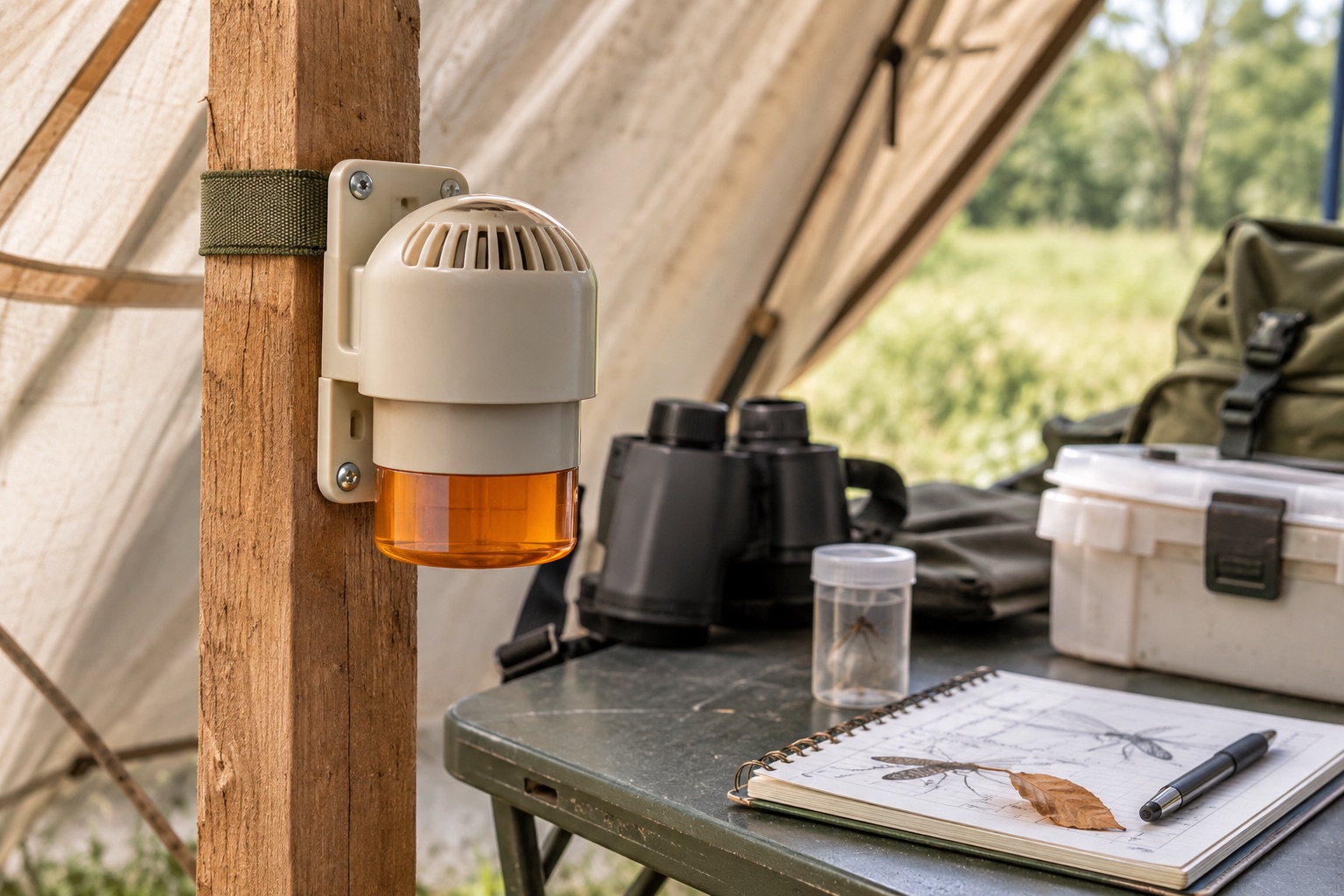 FIELD EVIDENCE 015 · PASSIVE SHELTER EMANATOR
01The humanitarian crisis gap: why bed nets and indoor spraying fail in displacement camps
For more than twenty years, international vector-control policy has rested on two core tools: pyrethroid-treated bed nets and indoor wall spraying. Under stable suburban or rural conditions with solid brick, plaster, or seasoned timber walls, this combination has saved millions of lives. However, in humanitarian crisis settings such as the protracted displacement camps of Borno State, both interventions experience compounding operational points of failure.
First, standard bed nets require intact structural enclosure. An insecticidal net cannot protect a sleeping child if the shelter lacks secure hanging beams, if torn plastic tarpaulins expose the interior to cross-winds, or if multiple families must crowd onto single floor mats. Furthermore, during high-temperature dry and humid seasons, night-time temperatures inside uninsulated plastic tents frequently exceed 35 degrees Celsius. Household members routinely sleep outdoors in shared courtyards, alleys, or open verandas where bed nets cannot be erected. Entomological surveys across Sub-Saharan Africa reveal that up to 40 percent of infective bites from Anopheles gambiae and Anopheles funestus occur during early evening hours (18:00 to 21:00) before children go to bed, or in the early dawn before sunrise.
Second, indoor residual spraying requires porous, stable wall substrates capable of absorbing chemical suspensions and slowly releasing micro-crystals over several months. In spontaneous displacement settlements, walls are built of scavenged plastic sheeting, woven straw mats, rusty corrugated tin, or untreated rough cardboard. Insecticides sprayed onto plastic sheeting drip off immediately or degrade rapidly under direct solar ultraviolet exposure, failing to establish the residual chemical barrier necessary for transmission interruption.
Third, vector biology has evolved rapidly. In Northern Nigeria and across West Africa, Anopheles gambiae sensu lato populations carry near-saturation levels of target-site knockdown resistance (kdr) point mutations in their voltage-gated sodium channels, coupled with elevated cytochrome P450 monooxygenases and glutathione S-transferases. Even when mosquitoes land directly on standard pyrethroid nets, mortality is often negligible. The vector-control community urgently required a modality that could operate passively without electricity, require zero structural modifications, function in ventilated spaces, and bypass tarsal contact resistance through vapour-phase deterrence.
02The Maiduguri trial: 24 IDP camps, 1,655 children, and a 29% incidence reduction
To establish whether passive spatial repellents can deliver real-world epidemiological protection in severe emergencies, an international consortium funded by the US Department of the Army and humanitarian partners executed a six-month pragmatic, open-label, cluster-controlled trial (NCT06179732). The study was situated in Maiduguri, the capital of Borno State, Nigeria, an epicenter of protracted armed displacement where hundreds of thousands of people reside in informal camp clusters under intense seasonal malaria transmission.
The investigators enrolled 1,655 children aged 6 to 10 years across 24 spatially segregated IDP camps between June 20 and July 3, 2023, tracking cohorts through the entire six-month transmission season. Twelve camps were randomly allocated to receive the spatial repellent intervention, while twelve matched camps served as the contemporary control receiving standard camp care. In each intervention cluster, long-lasting spatial repellent emanators containing volatile transfluthrin were deployed at manufacturer-specified density (one emanator per living enclosure, covering up to 50 eligible households per camp) and mounted on interior posts or ceiling purlins by field entomologists or supervised householders.
The epidemiological findings, released in The Lancet Infectious Diseases, revealed decisive protective benefits:
- Malaria Infection Incidence: Over six months of monthly blood smear and rapid diagnostic testing, children in the intervention camps experienced a 28.7 percent reduction in malaria infection incidence compared to controls (adjusted incidence rate ratio 0.713, 95% CI 0.584 to 0.869; p = 0.001).
- First Infection Hazard: The hazard ratio for time to first documented malaria infection was 0.775 (95% CI 0.637 to 0.943; p = 0.011), corresponding to an adjusted protective efficacy of 22.5 percent.
- Vector Density Collapse: Monthly indoor CDC light-trap and pyrethrum spray catch monitoring demonstrated an astonishing entomological impact against pyrethroid-resistant female Anopheles gambiae sensu lato, with vector density dropping by 97.7 percent in treated shelters (incidence rate ratio 0.0231, 95% CI 0.00661 to 0.0807; p < 0.0001).
- Blood-Feeding Disruption: The proportion of blood-fed female mosquitoes captured indoors collapsed by 98.0 percent (incidence rate ratio 0.0195, 95% CI 0.00590 to 0.0646; p < 0.0001), indicating that volatile emanators nearly eliminated indoor biting even if an occasional mosquito crossed the threshold.
- Community Acceptability: Focus group discussions conducted with camp leaders, mothers, and household heads demonstrated overwhelming acceptability, driven by the visible absence of biting pests, with significant community willingness to maintain and purchase devices.
03Passive emanators versus active vaporizers: Mali, Tanzania, and field performance gaps
The success of the Maiduguri trial highlights an essential distinction that consumers and vector-control managers often confuse: the difference between passive volatile spatial emanators and active heated thermal vaporizers or combustion coils.
Passive long-lasting spatial emanators (such as the transfluthrin membrane devices used in the humanitarian trial) rely solely on the ambient vapour pressure of specialized fluorinated pyrethroid active ingredients. At typical tropical temperatures (20 to 40 degrees Celsius), the active ingredient continuously sublimes or diffuses through a microporous plastic film, creating a steady, sub-lethal protective vapour concentration throughout a 10 to 15 square meter living space for six continuous months. They consume no battery power, burn no butane, emit no particulate smoke, and pose zero fire hazard in densely packed tent settlements where open flames frequently trigger catastrophic fires.
In contrast, consumer devices sold for backyards and patios, such as butane-heated or battery-powered repellers, require active thermal heating to vaporize concentrated transfluthrin or metofluthrin mats or liquid cartridges. A comprehensive 2026 field study published in Frontiers in Insect Science (Frontiers in Insect Science 2026, Mali Field Trial) tested six commercial devices under standardized wind-controlled field conditions in paired urban (Aedes-dominated) and rural (Anopheles-dominated) sites in Mali, West Africa. The investigators discovered striking contrasts across product categories:
- Heated Transfluthrin Devices: Electronic heated units containing 5.5% to 8.83% transfluthrin reduced mean Anopheles catches from 34.96 in controls down to 1.63 and 2.50 mosquitoes per trap in rural Mali, and reduced Aedes from 14.33 to 0.88 to 0.96 in urban plots (Dunnett p < 0.01).
- Mosquito Coils: Pyrethrin and meperfluthrin mosquito coils showed moderate but erratic, inconsistent protection, with wide night-to-night fluctuations influenced by wind speed and burning rate.
- Citronella and Ultrasonic Scams: Citronella candles and oscillating ultrasonic devices demonstrated zero statistically significant protection compared to untreated controls, confirming that ultrasonic gadgets remain worthless pseudoscience and botanical candles cannot establish protective spatial vapour fields outdoors.
These findings align with prior semi-field trials in Tanzania (PLOS ONE 2025, Tanzania Semi-Field Trial), where passive BiteBarrier emanators provided 93 percent indoor bite protection and 80 percent outdoor bite protection over eight weeks across five mosquito colonies, and ongoing cluster-randomised trial protocols in Uganda (Trials 2026, Mossie-GO Trial Protocol). However, as demonstrated in Benin experimental huts (Scientific Reports 2026, Benin Hut Trial), spatial repellency operates best in enclosed or semi-enclosed spaces with controlled air turnover; in open, high-wind settings, volatile molecules dilute rapidly below the minimum threshold required for flight deterrence.
| INTERVENTION CLASS | ACTIVE MOLECULE & DELIVERY | ENTOMOLOGICAL PROFILE (RESISTANT VECTORS) | TRIAL INCIDENCE / EFFICACY | OPERATIONAL VERDICT |
|---|---|---|---|---|
| Passive Long-Lasting Spatial Emanator (LLSE) | Transfluthrin (passive ambient diffusion, 6-month matrix) | 97.7% vector density reduction and 98.0% blood-feeding block in pyrethroid-resistant Anopheles (Maiduguri 2026). | 28.7% malaria incidence reduction (IRR 0.713, p=0.001); 22.5% protective efficacy against first infection. | GRADE A. Groundbreaking tool for displacement camps, open shelters, and semi-enclosed verandas. |
| Active Heated Spatial Repellers (Thermacell / Dynatrap) | Transfluthrin (5.5-8.8% thermal cartridge, butane/battery) | Reduces Anopheles catches from 35.0 to 1.6-2.5 in rural field trials (Mali 2026); strong short-term deterrence. | No clinical trial data on malaria disease incidence; provides temporary 2-4 hour perimeter reduction. | GRADE B (patio / outdoor). Highly effective for active outdoor gatherings; impractical for continuous overnight sleep. |
| Dual-Active Insecticidal Bed Nets (PBO / Chlorfenapyr) | Pyrethroid + PBO or Chlorfenapyr (tarsal contact net) | Overcomes metabolic P450 resistance through enzyme inhibition or mitochondrial uncoupling; lethal upon contact. | Proven 30-50% malaria incidence reduction in formal housing with structured beds. | GRADE A (structured bedrooms). Remains gold standard indoors where intact hanging beams exist. |
| Traditional Pyrethroid Mosquito Coils | Meperfluthrin / d-allethrin (combustion smoke) | Moderate but erratic catch reduction in field tests; subject to rapid wind dissipation and resistance loss. | Minimal epidemiological disease data; heavy particulate matter (PM2.5) respiratory hazard indoors. | GRADE C/D. High fire risk in tent settlements; dangerous respiratory emissions in enclosed spaces. |
| Citronella Candles & Ultrasonic Gadgets | Citronella oil vapor / ultrasonic acoustic frequency | Zero statistically significant reduction in mosquito captures in standardized trials (Mali 2026). | Zero clinical efficacy against malaria, dengue, or other arboviruses. | GRADE D (UNGRADED/SCAM). Complete waste of household funds; provides zero biological protection. |
Primary trial sources: Maiduguri humanitarian crisis trial (The Lancet Infectious Diseases 2026, Maiduguri IDP Trial, NCT06179732); Mali field evaluation (Frontiers in Insect Science 2026, Mali Field Trial); Tanzania semi-field evaluation (PLOS ONE 2025, Tanzania Semi-Field Trial); Uganda Mossie-GO protocol (Trials 2026, Mossie-GO Trial Protocol). Checked 2026-11-12.
04Translating evidence to operational vector defense: shelter design and household guidance
The formal inclusion of spatial repellents into the World Health Organization Guidelines for Malaria in late 2025, followed by the rigorous epidemiological evidence from the Maiduguri trial in 2026, marks a structural shift in global vector control. Spatial repellents are no longer merely lifestyle conveniences for suburban barbecues; they are validated humanitarian tools capable of preventing life-threatening parasitic infections in the world's most vulnerable populations.
To maximize protective value while avoiding misuse, public health teams and individual households should implement four evidence-based operational rules:
1. Deploy passive emanators where bed nets cannot hang. The primary ecological niche for long-lasting spatial emanators is inside structures where physical bed nets fail: informal refugee tents, open-eaved rural huts, screened verandas, semi-enclosed kitchens, and emergency transit centers. In these zones, mount emanators at a height of 1.5 to 2.0 meters on central wooden uprights or ceiling purlins, away from open doorway drafts that prematurely dilute the active vapour plume.
2. Maintain dual protection for sleeping areas. Spatial emanators complement, but do not fully replace, next-generation insecticidal bed nets. In bedrooms where intact structural hanging points exist, families should sleep under dual-active (pyrethroid plus chlorfenapyr or PBO) bed nets while using spatial emanators to protect the broader living space during evening dining and morning study hours.
3. Never rely on passive emanators in open outdoor wind. Passive emanators depend on establishing a stable equilibrium concentration of volatile active molecules in ambient air. In open outdoor fields or high-wind courtyards, air turnover sweeps molecules away faster than diffusion occurs. For outdoor work, farming, or evening gatherings, individuals must continue to rely on EPA-registered topical repellents (DEET, picaridin, or IR3535) applied directly to exposed skin.
4. Eliminate breeding sites mechanically. Chemical and spatial interventions protect the air, but larval mosquitoes breed in water. No spatial emanator prevents eggs from hatching in discarded tins, unsealed water drums, or blocked roof gutters. Weekly execution of the ten-minute yard survey and the deployment of autocidal gravid ovitraps remain the most cost-effective mechanical baseline for vector suppression.
05Frequently asked questions
Do spatial repellent emanators work when mosquitoes are resistant to pyrethroid sprays?
Yes. In the 2026 Maiduguri humanitarian trial published in The Lancet Infectious Diseases, passive transfluthrin emanators reduced pyrethroid-resistant Anopheles gambiae density by 97.7 percent and blood feeding by 98.0 percent. Although transfluthrin shares the sodium-channel target, ambient vapour concentrations cause sensory disorientation and flight avoidance before mosquitoes make physical contact with walls.
Can spatial repellent emanators replace bed nets in malaria prevention?
No, they are complementary rather than a total replacement. While spatial emanators achieved a 28.7 percent reduction in malaria incidence in open displacement shelters where nets could not be hung, the World Health Organization recommends using them alongside next-generation dual-active bed nets (pyrethroid plus chlorfenapyr or PBO) whenever intact bedroom hanging structures exist.
What is the difference between passive spatial emanators and mosquito coils or heated vaporizers?
Passive emanators diffuse active vapor naturally at ambient room temperature over six months without flame, batteries, or electricity, avoiding fire risks and toxic PM2.5 smoke. Active heated devices (such as Thermacell) require butane fuel or battery power for short outdoor windows, while traditional combustion coils produce hazardous particulate smoke with erratic field performance.